Friday, April 11, 2008

Sean has poor reading skills at 6am

I've been burning my candle at both ends this week and not for any really good reason. Okay, maybe it is a good reason. My husband has been working long hours all week (leaving at 6:30am and not getting home until 9 or 10 at night) and if we want to talk to each other at all, we both have to stay up really late. Neither of us has had more than four or five hours of sleep per night all week. Normally, I can deal with sleep deprivation but, man, have I been dragging all week long. I've also had a terrible, pounding headache, too. I was beginning to think I might be coming down with something.

This morning, I staggered into the kitchen at a quarter of six to make coffee. I dumped the water in the coffee maker, put the coffee in the filter then just sort of stood there for a minute, staring at the bag of coffee I started using on Monday. It was then I noticed an unfamiliar word on the bag: D-E-C-A-F.

Sort of explains it all, doesn't it?

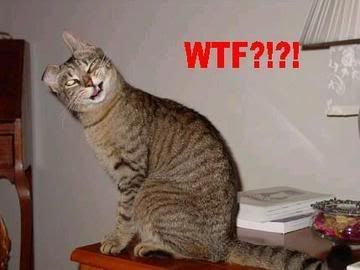
sleepy cat zzzz


Trying. So hard. To. Stay awake.

Thursday, March 27, 2008

'Scuse Me While I Kiss This Fly

It was August 28th, 1992. My first semester of college. I and some of my newly found best friends headed out from the dorms at Wichita State University for some college hijinks. There were six of us in the car (a 1978 Cadillac Deville), listening to the city’s classic rock station at an obscene volume and singing along at an equally obscene volume. The song “Blinded by the Light” by Manfred Mann’s Earth Band came on. We belted out the lyrics.

Then it happened.

We came to the line “Revved up like a deuce, another runner in the night.” I loudly sang what I thought was the line. Everyone stopped singing. The driver turned down the radio.

“What did you just say?”


I repeated the line. The car erupted in laughter. And that was the day I learned the song doesn’t go “Wrapped up like a douche, another roller in the fight.”

Go ahead. Laugh. It is kinda funny. I always wondered what they meant by that line anyway.

On a related note, I was once sitting in a radio station with another DJ. We’d been talking but lapsed into silence while the No Doubt song “Spiderwebs” was playing. At the end of the song is the line “Leave a message and I’ll call you back.” As soon as it played, the other DJ commented in an offhand manner “Why do you think she wants to leave a message for Carl Eubanks?”

Any embarrassingly misheard lyrics in your past?

Sunday, February 10, 2008

Geology, Geograhy and Me

I have something embarrassing to admit. It requires a bit of background so bear with me.

I was 6 years old in 1980 when Mount St. Helens erupted in Washington (the state. This distinction will be important later). It was all over the news and I was way into because … I was 6 and volcanoes are waaay cool to six-year-olds. Especially when they live in the middle of the country, far, far, away from the eruption. For some reason still unclear to me, my great-aunt in Washington D.C. (yet another important distinction) sent my grandmother a bit of ash from the eruption. So, if you’ll follow my six-year-old logic. Mt. St. Helens + Washington + Aunt Gladys + Washington = Mount St. Helens is in Washington D.C.

See? That makes perfect sense, doesn’t it?

Fast forward to my sophomore year of college and my Geology 101 (aka Geology for Liberal Arts majors) class. My professor was talking about the eruption when, like a lightning bolt from the sky, it struck me: MOUNT ST. HELENS IS IN WASHINGTON STATE!!!

Truly, I felt as though I’d been living a lie. And I also felt like a complete dumbass because I’d never corrected my faulty, six-year-old reasoning. This was the most complete and absolute “blonde” moment of my life. And I made the mistake of telling my husband about it. Being an engineer, he NEVER lets me forget it.

The point of my story: We were watching a program about what would happen if the seething caldera that is Yellowstone National Park were to ever explode. My seven-year-old son asked where Mount St. Helens was located and my husband replied “Washington.” My son thought about that for a moment.

Then he asked: “Washington state or Washington D.C.?”

Friday, February 8, 2008

A Death in the Fictional Family

I was reading another writer's (who shall remain nameless) blog the other day in which this person was despondent over the death of a character. It made me curious as to how others handle eliminating characters. Sure, I've shed a few tears over the deaths of characters written by others, (I STILL bawl like a baby when the little girl dies in Bridge to Terabithia.) but never over my own characters. In fact, I take a fiendish pleasure in devising good ways to remove characters (I have a particularly good death ready for one of my Seals characters. Bwahahaha.). I was discussing this with my stepdaughter Shekey last night and she told me, "It's a good thing you aren't a criminal, because you'd probably be a serial killer." Shekey has a wry sense of humor.


Writers: How do you feel about killing off your characters?

Everyone: Any particular fictional death scenes that really make you turn on the waterworks?

Sunday, December 23, 2007

Religion versus Belief

I was doing some demon research online today and I came across a message board about the new A&E show Paranormal State. It's a reality show that chronicles the adventures of a group of Penn State students who investigate the paranormal. On last week's episode, the team encountered what they believed to be a demonic entity and they made a big deal of not saying its name (though the show later revealed it).


The interesting thing I discovered when I browsed through the thread about this particular episode was this: People who watched the show and have what seems to be a belief in the existence of the paranormal were angry because the investigators turned to Christianity for the solution. There was an inexplicable amount of comments like "I can't believe people believe this bullsh!t (referring to religion)." Bear in mind this was from people WHO BELIEVE IN GHOSTS! Few people took issue with the question of whether or not the person might be demonically possessed. That seemed to be a given. What bothered them was that the Catholic Church might have the solution.


Yeah, I had a hard time understanding that myself.


Personally, I don't care about what others believe. I think faith is a personal journey and if you look for God, you'll find Him. That's up to you. I also tend to think that there's more than one way to find Him. This leads to the fine line that I walk when I write. If you've read the First Seal, then you know that. I'm not preachy about religion but I think it's important. I am a bit concerned though, because my current WIP features a lot of paranormal activity and I am trying to find the right balance of that and religion. I know that's vague but I don't want to give out any plot spoilers. (Subliminal advertising: BUY MY BOOK!). I'm looking for some sort of balance that won't raise the ire of my target market and also won't get me kicked out of The Christian Writers Guild (though I'm pretty sure they should never, ever read my work. I get the feeling they wouldn't like it.)


I've had discussions with friends of all religious stripes including atheists (and if you think I might be talking about you, then I probably am) regarding the basis of belief or the lack of it. I'm more interested in what people believe and why they believe it than I am in winning some sort of argument.


So, let's hear it. What are your thoughts?

Wednesday, December 5, 2007

The Moral of the Story is "Don't Give Up."

(I grabbed this from The World in Grey's blog. 'Tis the season for encouragement. Ho, ho, ho.)


The Good Earth by Pearl S. Buck was returned fourteen times, but it went on to win a Pulitzer Prize.

Norman Mailer's The Naked and the Dead was rejected twelve times.

Patrick Dennis said of his autobiographical novel Auntie Mame, "It circulated for five years through the halls of fifteen publishers and finally ended up with Vanguard Press, which, as you can see, is rather deep into the alphabet." This illustrates why using the alphabet may be a logical but ineffective way to find the best agent or editor.

Twenty publishers felt that Richard Bach's Jonathan Livingston Seagull was for the birds.

The first title of Catch-22 was Catch-18, but Simon and Schuster planned to publish it during the same season that Doubleday was bringing out Mila 18 by Leon Uris. When Doubleday complained, Joseph Heller changed the title. Why 22? Because Simon and Schuster was the 22nd publisher to read it. Catch-22 has become part of the language and has sold more than 10 million copies.

Mary Higgins Clark was rejected forty times before selling her first story. One editor wrote: "Your story is light, slight, and trite." More than 30 million copies of her books are now in print.

Before he wrote Roots, Alex Haley had received 200 rejections.

Robert Persig's classic, Zen and the Art of Motorcycle Maintenance, couldn't get started at 121 houses.

John Grisham's first novel, A Time to Kill, was declined by fifteen publishers and some thirty agents. His novels have more than 60 million copies in print.

Thirty-three publishers couldn't digest Chicken Soup for the Soul, compiled by Jack Canfield and Mark Victor Hansen, before it became a huge best-seller and spawned a series.

The Baltimore Sun hailed Naked in Deccan as "a classic" after it had been rejected over seven years by 375 publishers.

Dr. Seuss's first book was rejected twenty-four times. The sales of his children's books have soared to 100 million.

Louis L'Amour received 200 rejections before he sold his first novel. During the last forty years, Bantam has shipped nearly 200 million of his 112 books, making him their biggest selling author.

If you visit the House of Happy Walls, Jack London's beautiful estate in Sonoma County, north San Francisco, you will see some of the 600 rejection slips that London received before selling his first story.

British writer John Creasy received 774 rejections before selling his first story. He went on to write 564 books, using fourteen names.

Eight years after his novel Steps won the National Book Award, Jerzy Kosinski permitted a writer to change his name and the title and send a manuscript of the novel to thirteen agents and fourteen publishers to test the plight of new writers. They all rejected it, including Random House, which had published it.

Tuesday, December 4, 2007

Decisions, Decisions

I have reluctantly taken a break from writing this week because I needed to finish up edits on The Second Seal. I've got a couple more things to fix and it will be finished. Finally.


There is one thing about it that I'm not sure how I want to fix it. That's where you, my audience of experts, come in. I want your opinion on it.


Here's the situation: I have a character that uses two names. One is his real name and the other is an alias. The protagonist learns his real name, but not his alias. On the first edit, I thought it might be a little confusing to keep referring to the one character by two different names, so after revealing his real name, I referred to him only by his alias. I did this even when writing from the protagonist's POV (though he never refers to him by name in dialogue).


On this edit, however, a trusted friend suggested that I change it back.


Which way should I go on this?


I can provide examples if asked.